
-Lemon-Flavored-uitgesneden-image_square.png)

Your cart is empty
Go to the shop
 01/10/2025
Endurance gels have become a cornerstone of fuelling in long-distance sport. Compact and practical, they provide concentrated carbohydrate in a form designed to be absorbed quickly and used efficiently during exercise. For endurance athletes, they are often the most convenient way to meet the high energy demands of training and racing.
An endurance gel is a single-serve source of carbohydrate, typically providing between 20–50 g per serving. In gel form, carbohydrates are digested and absorbed rapidly, supplying the muscle and brain with energy when it is needed most.
Most formulations combine carbohydrates with electrolytes, and sometimes caffeine. The goal is consistent: deliver fuel fast, support hydration, and remain gentle on the gut during prolonged effort.
Carbohydrate is the primary fuel for high-intensity endurance work. At pace, the body cannot rely on fat alone. Glycogen stores in muscle and liver are limited and typically deplete within 70–90 minutes. Fatigue sets in when glycogen runs low, making carbohydrate intake during exercise essential to maintain performance.
During racing or high-intensity sessions, energy expenditure can exceed 1.000 kcal per hour. Internal glycogen stores cover only a fraction of that demand. To keep pace, athletes must supply external carbohydrate - often 90–120 g per hour - to match output and sustain intensity. Without this, depletion and performance loss are inevitable.
The small intestine absorbs glucose via the SGLT1 transporter, but this pathway has a ceiling - roughly 60 g per hour. Consuming only glucose-based fuels risks creating a bottleneck, leading to both limited energy delivery and increased gastrointestinal strain.
Fructose, however, is absorbed via a separate pathway (GLUT5). By combining glucose and fructose, athletes can raise total carbohydrate absorption above 90 g per hour. This parallel pathway strategy is now a well-established principle in sports nutrition.
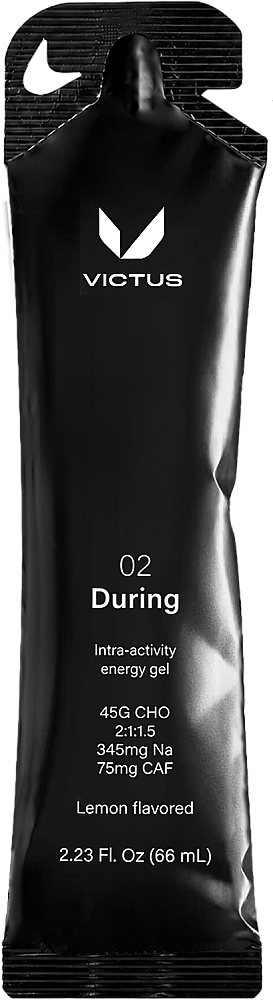
Victus 02 During builds on this research. Each gel contains 45 g of carbohydrate from maltodextrin, glucose, and fructose in a 2:1:1,5 ratio.
By distributing the load across multiple pathways, this Triple-Carb Formula increases uptake while reducing gut stress.
Each gel also provides 343 mg sodium, the primary electrolyte lost through sweat. Sodium enhances fluid absorption in the gut, maintains plasma volume, and supports muscle function during long-duration effort.
The combination of carbohydrate and sodium creates a fuelling system that is not only energy-dense but also hydration-efficient - a critical factor when training or racing in hot or high-intensity conditions.
Gastrointestinal distress is one of the most common reasons athletes underperform in endurance events. Cramping, nausea, or bloating can derail performance more quickly than depleted legs.
By controlling osmolarity and distributing absorption across parallel pathways, the Triple-Carb Formula is designed to be gentle on the gut, even at high carbohydrate intakes of 90–120 g per hour.
Like muscles, the gut adapts to training. Regular exposure to higher carbohydrate intakes improves comfort and absorption capacity. Integrating 02 During into long training sessions conditions the digestive system, lowering the risk of GI distress on race day and making higher fuelling strategies sustainable.
Research shows that carbohydrate blends can deliver and oxidise up to 1.7 g per minute, compared with 1 g per minute from glucose alone. That difference translates directly into higher exercise intensities sustained for longer. In practical terms, fuelling with gels helps to:
The outcome is simple: more fuel delivered, more performance sustained.
The optimal fuelling strategy depends on training load, session duration, and intensity. With 45 g carbohydrate and 343 mg sodium per gel, 02 During fits into a structured intake plan:
Fuelling strategies should be tested in training. Consistency allows both muscles and gut to adapt, improving tolerance and efficiency.
02 During has been validated with elite professionals in both training and racing environments. Consistent fuelling, session after session, builds resilience and allows athletes to hold performance under pressure.
Endurance performance is limited not only by physiology, but by fuelling. The Triple-Carb Formula in the Victus 02 During Gel is designed to solve the absorption challenge: three carbohydrates, two pathways, one system.
By controlling osmolarity, supporting hydration, and remaining gentle on the gut, it delivers more energy where it matters. Keeping athletes on pace, fuelling to last, not fade.